
Field Guide
TL;DR: Terpenes are the aromatic compounds that give cannabis its smell and flavor. That part is settled. Whether they meaningfully change your high is far less settled than the internet suggests — the popular “entourage effect” claim is plausible but not clinically proven. Terpene info is still useful. Just not as a guarantee.
Ask around a dispensary and you will hear a confident story: forget THC percentage, terpenes are what really determine your experience. It is a satisfying story, it is repeated everywhere, and it is more of a hypothesis than a fact.
We would rather give you the honest version, because it is still genuinely useful — just useful in a different way than the sales pitch suggests.
What terpenes actually are
Terpenes are aromatic compounds produced by cannabis and thousands of other plants. They are what your nose is picking up when one jar smells like lemon peel and the next smells like diesel or pine needles.
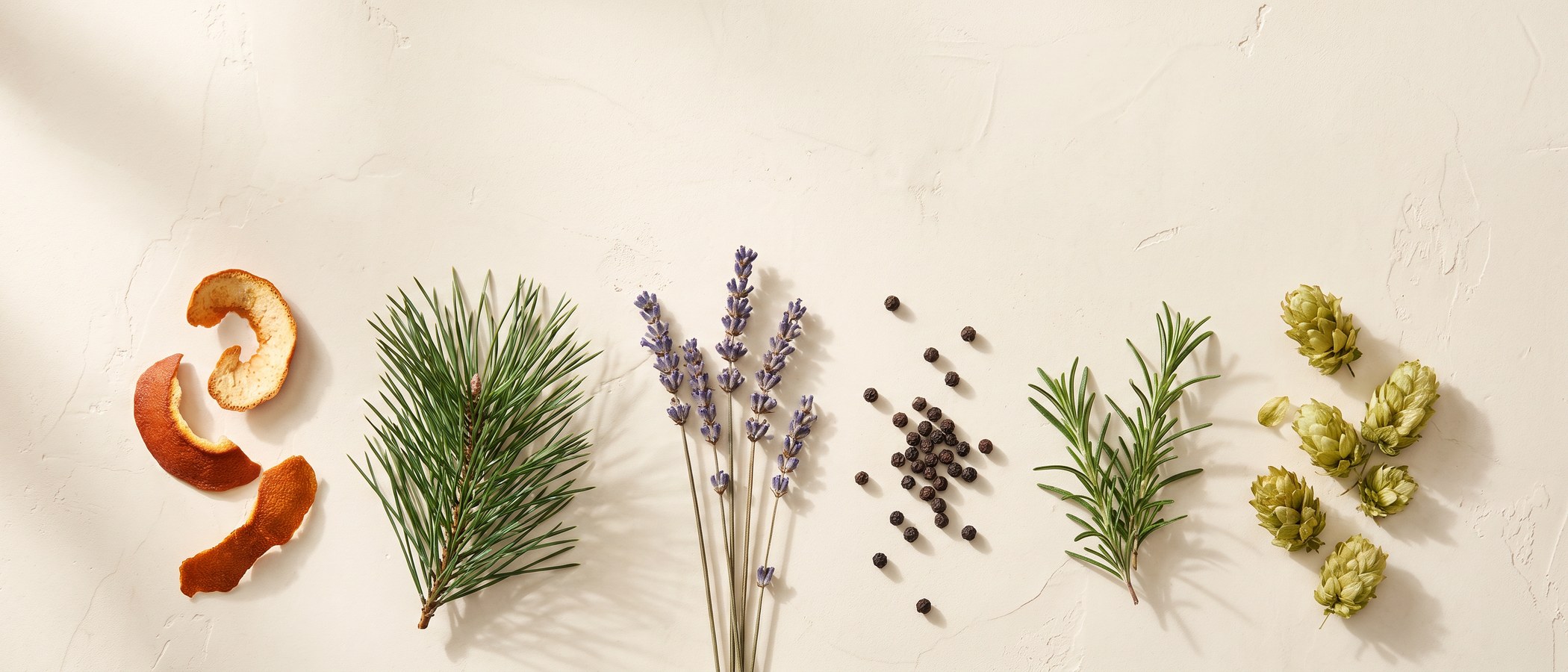
They are not unique to cannabis, which is the fastest way to understand them. The same compounds show up in hops, lavender, pine resin, black pepper, and citrus rind. Cannabis just happens to produce a lot of them, in combinations that vary by cultivar.
On a lab label, terpene content is usually reported as a percentage of total weight — typically somewhere between 1% and 3% for flower. A higher total terpene number generally indicates a more aromatic product, and often a fresher one, since terpenes degrade with heat, light, and time.
The ones you will actually see on a label
| Terpene | Smells like | Also found in |
|---|---|---|
| Myrcene | Earthy, herbal, slightly musky | Hops, mango, thyme |
| Limonene | Citrus, bright, sharp | Citrus peel, juniper |
| Caryophyllene | Peppery, spicy, woody | Black pepper, cloves |
| Pinene | Pine, fresh, sharp | Pine needles, rosemary |
| Linalool | Floral, soft, lavender-like | Lavender, coriander |
| Terpinolene | Fruity, floral, faintly herbal | Apples, nutmeg, cumin |
You will find charts online assigning each of these a tidy effect — myrcene for sleep, limonene for mood, pinene for focus. Those associations come mostly from early lab work and a lot of repetition. They are not established in humans consuming cannabis.
The honest state of the science
Here is where most terpene articles overstate things, so we will be specific about what is known.
What the evidence does not support
A 2020 study in Frontiers in Pharmacology tested five of the most common cannabis terpenes — myrcene, alpha-pinene, beta-pinene, beta-caryophyllene, and limonene — and found they did not meaningfully act at CB1 or CB2 cannabinoid receptors, alone or alongside THC. They did not shift THC's potency or efficacy in those tests.
A 2024 systematic review in Pharmaceuticals reached a similar conclusion at a higher level: the potential for terpenes to synergistically enhance cannabinoid effects remains unproven. The authors called for clinical trials that have not yet happened.
Unproven is not the same as disproven.
Both studies were explicit that they could not rule out an entourage effect through other biological pathways. The evidence just isn't there yet.
What the evidence does suggest
The picture is not empty. Several findings are real and worth knowing:
- Full-spectrum extracts have outperformed isolated cannabinoids in multiple studies. Something about the whole-plant mix appears to matter — the open question is what, and whether terpenes are the reason.
- CBD genuinely modulates THC by affecting how the body metabolizes it. That interaction is better established than the terpene one.
- Individual terpenes show effects in isolation in exploratory research — linalool and sleep, limonene and pain response, caryophyllene and inflammation. These are early findings in lab and animal models, not proof of what happens when you smoke a joint.
- Aroma shapes subjective experience. This is not nothing. Expectation and sensory input demonstrably influence how people report an experience, in cannabis and well beyond it.
So how should you use terpene info?
Practically, this is the part that matters. Terpene data is worth paying attention to — for reasons that survive the uncertainty.
- As a flavor forecast. This is the strongest, best-supported use. If you know you like citrus-forward products, limonene content tells you something real.
- As a freshness signal. Terpenes degrade fast. A high total terpene percentage usually means the product was handled, cured, and stored well.
- As a way to find things you liked before. If a particular jar worked for you, its terpene profile is a far better search key than the strain name, which is notoriously inconsistent between growers.
- Not as a guaranteed effect. Buying myrcene-heavy flower expecting sedation may work out. It may not. Your tolerance, dose, format, setting, and mood all have stronger claims on the outcome.
What actually predicts your experience
If terpenes are a weaker predictor than advertised, and THC percentage is also a weaker predictor than advertised — and it is, as we covered in our guide to high THC — what is left?
Mostly the boring answers: your dose, your tolerance, your consumption method, and your setting. A modest dose of something fresh, taken somewhere comfortable, beats an optimized terpene profile taken carelessly. That is less exciting than a chart, and considerably more reliable.
Which is also why the budtender conversation is worth having. Not because anyone can predict your experience from a lab report, but because someone who knows what came in this week and what people keep coming back for has better information than any label.
Frequently asked questions
What are terpenes in cannabis?
Aromatic compounds responsible for smell and flavor. The same ones appear in hops, lavender, citrus peel, and pine.
Do terpenes change your high?
Genuinely unsettled. They clearly shape aroma and flavor. Whether they steer or amplify THC's effects has not been confirmed clinically — a 2020 study found five common terpenes did not act at cannabinoid receptors, and a 2024 review called the synergy unproven.
What is the entourage effect?
The theory that cannabis compounds work better together than alone. Broadly supported in that full-spectrum extracts often outperform isolates — but the specific terpene-amplifies-THC version is not established.
Should I shop by terpenes instead of THC percentage?
Use terpenes to predict flavor and gauge freshness, which they do well. Treat effect predictions as a hypothesis, not a promise.
Does a higher terpene percentage mean better cannabis?
It usually signals a fresher, well-handled product, which is a reasonable quality proxy. It does not guarantee you will prefer it.
Smell it before you commit to a theory
Our budtenders in Bridgeport, Hamden, Killingly, New London, and Torrington can tell you what's freshest on the shelf this week — which beats any chart.
Find your shop →21+ only. For use by adults in Connecticut. This post is educational and is not medical advice. Research on terpenes is evolving — claims here reflect published evidence as of July 2026. Keep out of reach of children. Do not drive under the influence.